
Commercial Waste Removal Tufnell Park — Recycling & Sustainability
Commercial waste removal in Tufnell Park is evolving to meet the twin challenges of increasing urban waste and cutting carbon emissions. This page explains our approach to creating an eco-friendly waste disposal area and a resilient, sustainable rubbish area across Tufnell Park and neighbouring boroughs. We set out targets, local logistics, partnerships and vehicle choices that help local businesses, property managers and developers move toward a circular economy while complying with borough-level waste separation practices.Our Recycling Percentage Target and Reporting
We have a clear recycling percentage target: a progressive plan to achieve a 70% recycling and reuse rate for collected commercial waste within five years. This recycling percentage target is monitored monthly and reported to clients in plain summaries. Achieving 70% means shifting business waste streams away from landfill through segregation, reuse, donation and recovery. Our commitment to transparency includes annual sustainability reports and tailored action plans for each client sector, from retail and hospitality to light industrial sites. Local infrastructure supports our operations. We route materials through nearby transfer stations and processing hubs that specialise in commercial loads and high-density collection.
Key local transfer stations we use include North London facilities and borough depots that serve Camden and Islington. Notable hubs include Edmonton/EcoPark-style facilities, Hendon transfer stations for bulk loads, and Islington’s council recycling depot for segregated streams. These facilities accept collections from commercial rubbish removal Tufnell Park services and send materials to material recovery facilities (MRFs), anaerobic digestion plants for food waste, and specialist glass and metal recyclers.
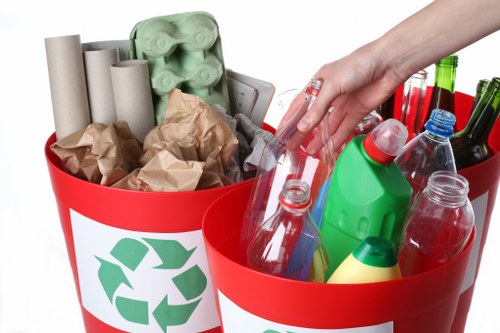
We work with the boroughs’ approach to waste separation: clear segregation of dry recycling, food and organic waste, glass, and residual general waste. Where local policy supports separate glass collections or expanded plastic sorting, our crews adapt collection containers and labels to match council guidance — helping clients meet local compliance and reduce contamination rates. Contamination control is a crucial part of reaching the recycling percentage target, so we provide clear, client-specific labelling and on-site staff training as required.
Partnerships with Charities and Reuse Networks
We place a high value on reuse. Partnerships with local charities and social enterprises are central to our sustainable rubbish strategy. Items that retain value — fixtures, office furniture, textiles, and usable equipment — are earmarked for donation or refurbishment rather than being sent for disposal. We collaborate with borough-based organisations and national charities that operate in Camden and Islington, establishing regular transfer schedules for suitable donations and creating a track-and-trace system so donors can see the outcome. These partnerships provide social value in addition to reducing the carbon footprint of waste management.Our commercial waste removal services in Tufnell Park also prioritise material-specific recycling activities relevant to the area: segregated food waste for anaerobic digestion; separate glass banks for neighbourhood collections; cardboard and mixed dry recyclables for MRF processing; and safe handling of electronic waste and batteries through certified e-waste channels. These streams reflect the boroughs’ emphasis on source separation to improve recycling yields.
Low-carbon logistics are another pillar of our sustainability plan. We operate a growing fleet of low-emission and electric vehicles designed for urban commercial waste routes. Our low-carbon vans include fully electric models for short urban routes, plug-in hybrids for mixed-distance collections, and modern Euro 6 diesel units where electrification is not yet viable. Route optimisation software minimises mileage and idle time, reducing emissions and traffic impact while improving efficiency for Tufnell Park commercial waste removal customers.
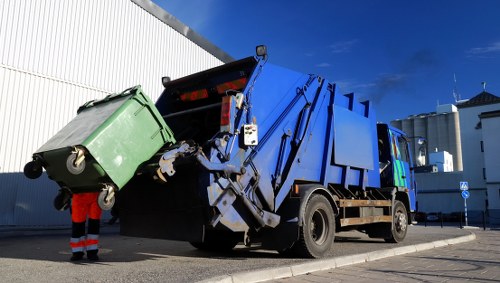 We combine fleet improvements with operational practices that cut embodied emissions: consolidated collections to reduce vehicle movements, timed collections to avoid peak congestion, and load maximisation practices that reduce the number of trips to transfer stations. These measures support a measurable carbon reduction target embedded in our sustainability plan.
 To make this practical for businesses we offer a set of standard commitments:
- Clear segregation guidance at source to reduce contamination.
- Regular donation pickups to local charities and reuse partners.
- Monthly recycling percentage reporting and continuous improvement meetings.
- Low-carbon vehicle deployment and route optimisation to cut Scope 1 emissions.
Our sustainable rubbish area strategy is designed to align with local policy while offering practical service options for businesses of all sizes. From curated waste audits and bespoke container solutions to scheduled charity handovers and certified transfer to specialised recyclers, every step is chosen to increase reuse and recycling rates and to lower the environmental impact of commercial waste removal in Tufnell Park.
In summary, our approach to eco-friendly waste disposal and a sustainable rubbish area combines ambitious targets, smart logistics, community partnerships and modern vehicles to create a robust, accountable service. By working with local transfer stations, charity partners and borough recycling schemes we aim to meet and exceed the recycling percentage target while supporting the local circular economy and reducing carbon across the Tufnell Park commercial waste removal landscape.